

Asking for a Friend: Can They Keep What You Built and Not Pay For It?


Founders, here’s a hypothetical. You meet a company with a good technical capability but no real commercialization engine around it. Founders spend years learning how to build value. The harder lesson is learning how to keep what you built when a partnership changes.
You build the website. You build the positioning. You build the funnels, campaigns, media, AI integration, digital infrastructure, capital-facing materials, market strategy, and the system that explains to the world why the product matters. The relationship gets serious enough that everyone signs an agreement.
That agreement says your company played a foundational role in commercialization.
It appoints you the exclusive commercialization, media, digital-infrastructure, and AI-integration partner.
It says you own the websites, marketing systems, media assets, workflows, AI assets, prompts, automation, and other digital infrastructure you created.
And then comes the important part:
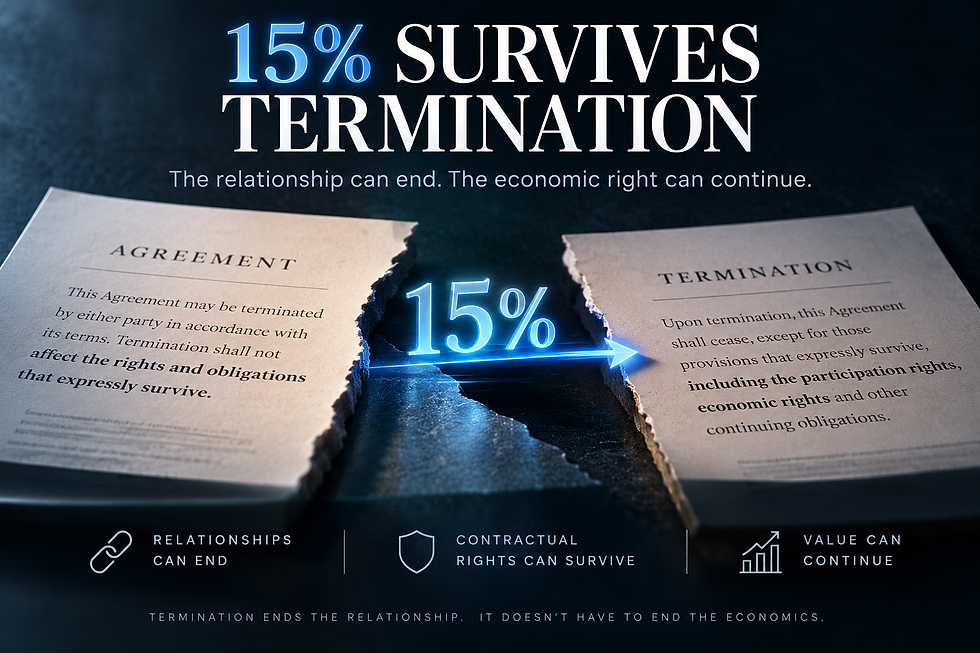
You receive 15% of Net Revenues from the business line. Not just from the leads you personally originated. Not just while you are actively working together. The agreement says the 15% survives termination and remains payable for the duration of the business line, even if the relationship ends.
So far, everybody is happy. You are building. They are using what you build. The product is being presented jointly. The website, the media, the campaigns, the strategy, and the commercialization machinery are all moving forward.
Then one day you say something that apparently changes the temperature in the room:
“You guys understand that this makes me an economic partner in what we’re building, right?”
And suddenly the word partner becomes controversial. The same people who were comfortable signing an agreement granting you 15% of the business line become extremely uncomfortable when you begin treating that 15% like an actual contractual right instead of decorative language. Soon thereafter, the relationship falls apart. Now here is where the hypothetical gets interesting. The other company does not abandon the product.

Quite the opposite.
It continues building the business.
It continues marketing the same category.
It begins publicly presenting the offering as its own proprietary platform. Today, for example, "That Company" publicly markets an “Advanced GIS Intelligence” platform combining land, grid infrastructure, environmental constraints, zoning, transportation, utilities, fiber, site scoring, and investment analysis.
Its current public marketing describes a proprietary GIS & Power Intelligence service that evaluates power, land, infrastructure, utilities, environmental issues, zoning, market conditions, development risk, scoring, and investor readiness. Its broader development platform now connects site intelligence, energy strategy, project development, and capital deployment.
Again, hypothetical. So the founder has a few questions. If the agreement says the 15% survives termination, does firing the commercialization partner somehow make the 15% disappear?
If the agreement says the participation lasts for the life of the business line, can one party simply remove the other party and continue operating the exact business?
If the agreement requires quarterly reporting of revenue, expenses, Net Revenue, and participation calculations, what happens if those reports stop arriving? And if the agreement specifically says the commercialization partner owns the websites, funnels, media, marketing systems, AI assets, workflows, prompts, and digital infrastructure it created, can the remaining company continue using those assets—or derivatives of them—as though they were always its own?
There is also a more uncomfortable question. Suppose everything was fine until the founder actually pointed out what the contract meant. Suppose the work was welcomed.
The systems were welcomed. The website was welcomed. The marketing was welcomed.
The introductions were welcomed. The commercialization was welcomed.
But the moment the founder said, “Hold on. You agreed that my company participates economically in this,” the relationship suddenly became untenable. And then, after removing that founder, the company continued commercializing the very business that generated the participation right.
At what point does a breakup stop looking like an ordinary business disagreement and start looking like an attempt to separate someone from an economic interest that the contract specifically says cannot be terminated? I’m asking for a friend.

Because the lesson for founders is bigger than any one dispute:
Read the survival provisions.
Do not assume termination means your economic rights disappear. Do not confuse ownership of the underlying company or technology with ownership of the commercialization infrastructure you created.
And never allow someone to characterize you as “just a vendor” after they have already signed a contract recognizing that you created enduring enterprise value and are entitled to participate in it.
The most dangerous moment in a partnership may not be when the business fails.
Sometimes it is when the business begins to look valuable enough that somebody starts wondering whether they still want to share it.
Founders if this has also happened to you please reach out using the links below and we'll publish your story.




Comments